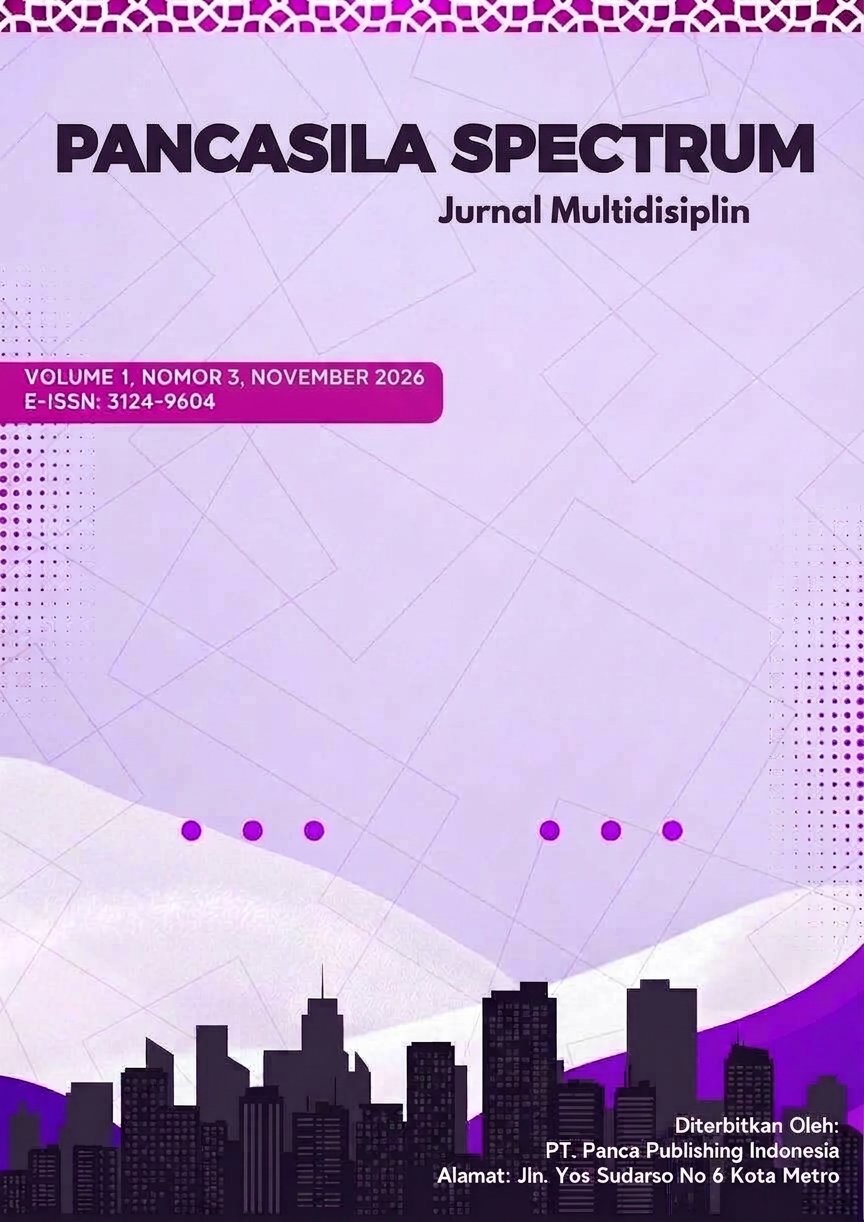
Peran Keluarga dalam Penggunaan Obat yang Rasional dan Aman Perspektif Islam: Upaya Mewujudkan Keluarga Sejahtera
DOI:
https://doi.org/10.67315/pancasilaspectrum.v1i03.174Keywords:
family, rational medication use, medication safety, Islamic perspective, family well-beingAbstract
The This study aims to analyze the role of families in promoting rational and safe medication use from an Islamic perspective and its relevance to family well-being. A qualitative approach using library research was employed. Data were drawn from scientific literature, reference books, and documents related to medication use, health literacy, and Islamic values. The data were analyzed descriptively and comparatively through the identification and synthesis of relevant themes. The findings indicate that families contribute to medication-related decision-making, medication literacy, behavioral development through role modeling, and communication among family members. The Islamic principles of protecting life (hifẓ al-nafs), trustworthiness, public benefit, and the prevention of harm provide an ethical foundation for responsible medication practices. These principles should be applied consistently with scientific evidence and professional healthcare consultation. The study concludes that strengthening family involvement through health education and the integration of Islamic values may support safer medication use and improved family well-being.
References
Ajzen, I. (1991). The theory of planned behavior. Organizational Behavior and Human Decision Processes, 50(2), 179–211. https://doi.org/10.1016/0749-5978(91)90020-T
Auda, J. (2008). Maqasid al-Shariah as philosophy of Islamic law: A systems approach. International Institute of Islamic Thought. https://iiit.org/en/book/maqasid-al-shariah-as-philosophy-of-islamic-law-a-systems-approach/
Bandura, A. (1986). Social foundations of thought and action: A social cognitive theory. Prentice-Hall.
Beauchamp, T. L., & Childress, J. F. (2019). Principles of biomedical ethics (8th ed.). Oxford University Press.
Berkman, N. D., Sheridan, S. L., Donahue, K. E., Halpern, D. J., & Crotty, K. (2011). Low health literacy and health outcomes: An updated systematic review. Annals of Internal Medicine, 155(2), 97–107. https://doi.org/10.7326/0003-4819-155-2-201107190-00005
Bowen, G. A. (2009). Document analysis as a qualitative research method. Qualitative Research Journal, 9(2), 27–40. https://doi.org/10.3316/QRJ0902027
Braun, V., & Clarke, V. (2006). Using thematic analysis in psychology. Qualitative Research in Psychology, 3(2), 77–101. https://doi.org/10.1191/1478088706qp063oa
Donaldson, L. J., Kelley, E. T., Dhingra-Kumar, N., Kieny, M.-P., & Sheikh, A. (2017). Medication without harm: WHO’s third global patient safety challenge. The Lancet, 389(10080), 1680–1681. https://doi.org/10.1016/S0140-6736(17)31047-4
Hogerzeil, H. V. (2004). The concept of essential medicines: Lessons for rich countries. BMJ, 329(7475), 1169–1172. https://doi.org/10.1136/bmj.329.7475.1169
Institute of Medicine. (2004). Improving medical education: Enhancing the behavioral and social science content of medical school curricula. The National Academies Press.
Kementerian Kesehatan Republik Indonesia. (2015, November 13). Menkes canangkan Gerakan Masyarakat Cerdas Menggunakan Obat. https://www.kemkes.go.id/id/menkes-canangkan-gerakan-masyarakat-cerdas-menggunakan-obat
Kementerian Kesehatan Republik Indonesia. (2023). Survei Kesehatan Indonesia 2023. Kementerian Kesehatan Republik Indonesia.
Maxwell, S. R. (2016). Rational prescribing: The principles of drug selection. Clinical Medicine, 16(5), 459–464. https://doi.org/10.7861/clinmedicine.16-5-459
Norman, C. D., & Skinner, H. A. (2006). eHealth literacy: Essential skills for consumer health in a networked world. Journal of Medical Internet Research, 8(2), Article e9. https://doi.org/10.2196/jmir.8.2.e9
Nutbeam, D. (2000). Health literacy as a public health goal: A challenge for contemporary health education and communication strategies into the 21st century. Health Promotion International, 15(3), 259–267. https://doi.org/10.1093/heapro/15.3.259
Nutbeam, D. (2025). Health literacy as a public health goal: 25 years on. Health Promotion International, 40(4), Article daaf119. https://doi.org/10.1093/heapro/daaf119
Ofori-Asenso, R., & Agyeman, A. A. (2016). Irrational use of medicines: A summary of key concepts. Pharmacy, 4(4), Article 35. https://doi.org/10.3390/pharmacy4040035
Sahin, A. (2018). Critical issues in Islamic education studies. Routledge.
Sørensen, K., Van den Broucke, S., Fullam, J., Doyle, G., Pelikan, J., Slonska, Z., & Brand, H. (2012). Health literacy and public health: A systematic review and integration of definitions and models. BMC Public Health, 12, Article 80. https://doi.org/10.1186/1471-2458-12-80
Susilawati, R., Ananda, & R. (2025). Menyatukan akal dan hati dalam pendidikan Islam: Studi di RQDT Lampung. Pendas: Jurnal Ilmiah Pendidikan Dasar, 10(2), 260–279. https://doi.org/10.23969/jp.v10i02.27211
World Health Organization. (2002). Promoting rational use of medicines: Core components (WHO Policy Perspectives on Medicines No. 5). https://apps.who.int/iris/bitstream/handle/10665/67438/WHO_EDM_2002.3.pdf
World Health Organization. (2017). Medication without harm: WHO global patient safety challenge. https://www.who.int/publications/i/item/WHO-HIS-SDS-2017.6
World Health Organization. (2019a). Medication safety in polypharmacy: Technical report. https://www.who.int/publications/i/item/WHO-UHC-SDS-2019.11
World Health Organization. (2019b). Medication safety in transitions of care. https://www.who.int/publications/i/item/WHO-UHC-SDS-2019.9
World Health Organization. (2023). Antimicrobial resistance. https://www.who.int/news-room/fact-sheets/detail/antimicrobial-resistance
World Health Organization. (2024). Global patient safety report 2024. https://www.who.int/publications/i/item/9789240095458
World Health Organization. (2025, December 22). Health literacy. https://www.who.int/news-room/fact-sheets/detail/health-literacy