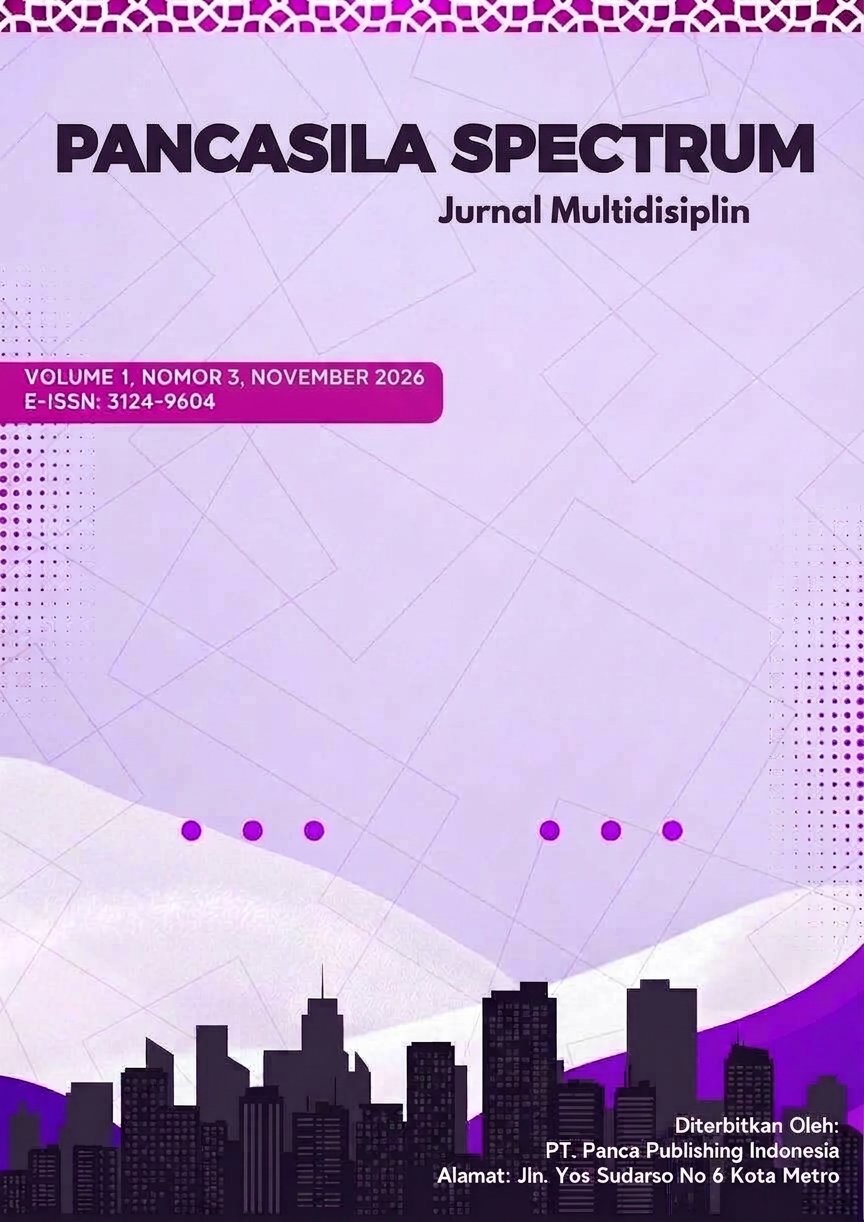
Peran Keluarga dalam Membangun Praktik Penggunaan Obat Rasional dan Aman Berdasarkan Nilai-Nilai Islam
DOI:
https://doi.org/10.67315/pancasilaspectrum.v1i03.171Keywords:
family, rational medication use, medication safety, Islamic values, protection of lifeAbstract
This study aims to analyze the role of families in promoting rational and safe medication use based on Islamic values. A descriptive qualitative approach was employed through a literature review. Data were obtained from the Qur’an, hadith, religious fatwas, health documents, and relevant scientific literature, then analyzed using thematic content analysis. The findings identify four major family roles: health decision-maker, medication-use supervisor, household medicine manager, and health educator. These roles support appropriate medication use, adherence to treatment instructions, safe medicine storage, and the prevention of inappropriate medication practices. From an Islamic perspective, these practices are consistent with the principles of protecting life (ḥifẓ al-nafs), trustworthiness, public benefit, and harm prevention. The study concludes that integrating medication literacy with Islamic values may strengthen family responsibility in maintaining health. However, empirical research is needed to examine how these principles are implemented in everyday family life.
References
Ajzen, I. (1991). The theory of planned behavior. Organizational Behavior and Human Decision Processes, 50(2), 179–211. https://doi.org/10.1016/0749-5978(91)90020-T
Al-Syatibi, I. (1997). Al-Muwafaqat fi ushul al-syari'ah. Dar Ibn Affan.
Auda, J. (2008). Maqasid al-Shariah as philosophy of Islamic law: A systems approach. International Institute of Islamic Thought. https://iiit.org/en/book/maqasid-al-shariah-as-philosophy-of-islamic-law-a-systems-approach/
Bandura, A. (1986). Social foundations of thought and action: A social cognitive theory. Prentice-Hall.
Beauchamp, T. L., & Childress, J. F. (2019). Principles of biomedical ethics (8th ed.). Oxford University Press.
Berkman, N. D., Sheridan, S. L., Donahue, K. E., Halpern, D. J., & Crotty, K. (2011). Low health literacy and health outcomes: An updated systematic review. Annals of Internal Medicine, 155(2), 97–107. https://doi.org/10.7326/0003-4819-155-2-201107190-00005
Bowen, G. A. (2009). Document analysis as a qualitative research method. Qualitative Research Journal, 9(2), 27–40. https://doi.org/10.3316/QRJ0902027
Braun, V., & Clarke, V. (2006). Using thematic analysis in psychology. Qualitative Research in Psychology, 3(2), 77–101. https://doi.org/10.1191/1478088706qp063oa
Chua, A. Q., Verma, M., Hsu, L. Y., Legido-Quigley, H., & colleagues. (2021). [Referensi dengan DOI 10.1186/s12889-021-11885-4 tidak cocok dengan judul yang dicantumkan dalam daftar awal; lihat catatan verifikasi di bawah.]
Ferdiana, A., Liverani, M., Khan, M., Wulandari, L. P. L., Mashuri, Y. A., Batura, N., & Wibawa, T. (2021). Community pharmacies, drug stores, and antibiotic dispensing in Indonesia: A qualitative study. BMC Public Health, 21, Article 1800. https://doi.org/10.1186/s12889-021-11885-4
Hogerzeil, H. V. (2004). The concept of essential medicines: Lessons for rich countries. BMJ, 329(7475), 1169–1172. https://doi.org/10.1136/bmj.329.7475.1169
Institute of Medicine. (2004). Health literacy: A prescription to end confusion. The National Academies Press. https://doi.org/10.17226/10883
Kementerian Kesehatan Republik Indonesia. (2013). Riset kesehatan dasar (Riskesdas) 2013. Badan Penelitian dan Pengembangan Kesehatan.
Kementerian Kesehatan Republik Indonesia. (2015a). Instruksi Menteri Kesehatan Nomor HK.02.02/MENKES/437/2015 tentang Gerakan Masyarakat Cerdas Menggunakan Obat.
Kementerian Kesehatan Republik Indonesia. (2015b). Menkes canangkan Gerakan Masyarakat Cerdas Menggunakan Obat. https://www.kemkes.go.id/id/menkes-canangkan-gerakan-masyarakat-cerdas-menggunakan-obat
Kementerian Kesehatan Republik Indonesia. (2018). Laporan nasional Riset Kesehatan Dasar 2018. Badan Penelitian dan Pengembangan Kesehatan.
Krippendorff, K. (2004). Content analysis: An introduction to its methodology (2nd ed.). Sage Publications.
Majelis Ulama Indonesia. (2013). Fatwa Majelis Ulama Indonesia Nomor 30 Tahun 2013 tentang obat dan pengobatan.
Muin, F., & Widayanti, A. W. (2023). Using simulated patients to understand non-prescription antibiotic dispensing in Indonesia: A systematic review. Jurnal Farmasi dan Ilmu Kefarmasian Indonesia, 10(2), 193–201. https://doi.org/10.20473/jfiki.v10i22023.193-201
Nutbeam, D. (2000). Health literacy as a public health goal: A challenge for contemporary health education and communication strategies into the 21st century. Health Promotion International, 15(3), 259–267. https://doi.org/10.1093/heapro/15.3.259
Nutbeam, D. (2025). Health literacy as a public health goal: 25 years on. Health Promotion International, 40(4), Article daaf119. https://doi.org/10.1093/heapro/daaf119
Norman, C. D., & Skinner, H. A. (2006). eHealth literacy: Essential skills for consumer health in a networked world. Journal of Medical Internet Research, 8(2), Article e9. https://doi.org/10.2196/jmir.8.2.e9
Ofori-Asenso, R., & Agyeman, A. A. (2016). Irrational use of medicines: A summary of key concepts. Pharmacy, 4(4), Article 35. https://doi.org/10.3390/pharmacy4040035
Rauf, Z., Putra, D. P., Masrul, M., & Semiarty, R. (2021). Knowledge, attitudes, and families practices in selecting, obtaining, using, storing, and disposing of medicines on self-medication behavior in Indonesia. Open Access Macedonian Journal of Medical Sciences, 9(E), 1570–1577. https://doi.org/10.3889/oamjms.2021.7700
Sari, O. M., Anwar, K., & Putri, I. P. (2021). Level of knowledge about storage and disposal of medicine at home in the community of Banjarbaru City, South Kalimantan. Cendekia Journal of Pharmacy, 5(2), 145–155. https://doi.org/10.31596/cjp.v5i2.141
Sørensen, K., Van den Broucke, S., Fullam, J., Doyle, G., Pelikan, J., Slonska, Z., & Brand, H. (2012). Health literacy and public health: A systematic review and integration of definitions and models. BMC Public Health, 12, Article 80. https://doi.org/10.1186/1471-2458-12-80
Undang-Undang Republik Indonesia Nomor 52 Tahun 2009 tentang Perkembangan Kependudukan dan Pembangunan Keluarga.
World Health Organization. (1985). The rational use of drugs: Report of the Conference of Experts, Nairobi, 25–29 November 1985. World Health Organization.
World Health Organization. (2002). Promoting rational use of medicines: Core components (WHO Policy Perspectives on Medicines No. 5). https://apps.who.int/iris/bitstream/handle/10665/67438/WHO_EDM_2002.3.pdf
World Health Organization. (2012). The pursuit of responsible use of medicines: Sharing and learning from country experiences (WHO/EMP/MAR/2012.3). https://www.who.int/publications/i/item/WHO-EMP-MAR-2012.3
World Health Organization. (2017). Medication without harm: WHO global patient safety challenge. https://www.who.int/publications/i/item/WHO-HIS-SDS-2017.6
World Health Organization. (2019a). Medication safety in polypharmacy: Technical report. https://www.who.int/publications/i/item/WHO-UHC-SDS-2019.11
World Health Organization. (2019b). Medication safety in transitions of care. https://www.who.int/publications/i/item/WHO-UHC-SDS-2019.9
World Health Organization. (2023). Antimicrobial resistance. https://www.who.int/news-room/fact-sheets/detail/antimicrobial-resistance
Zed, M. (2004). Metode penelitian kepustakaan. Yayasan Obor Indonesia.